Get in touch
Explore why FastAPI shines for AI integration in apps and web. Learn its speed, scalability, and SEO benefits for building AI-powered projects. 🚀
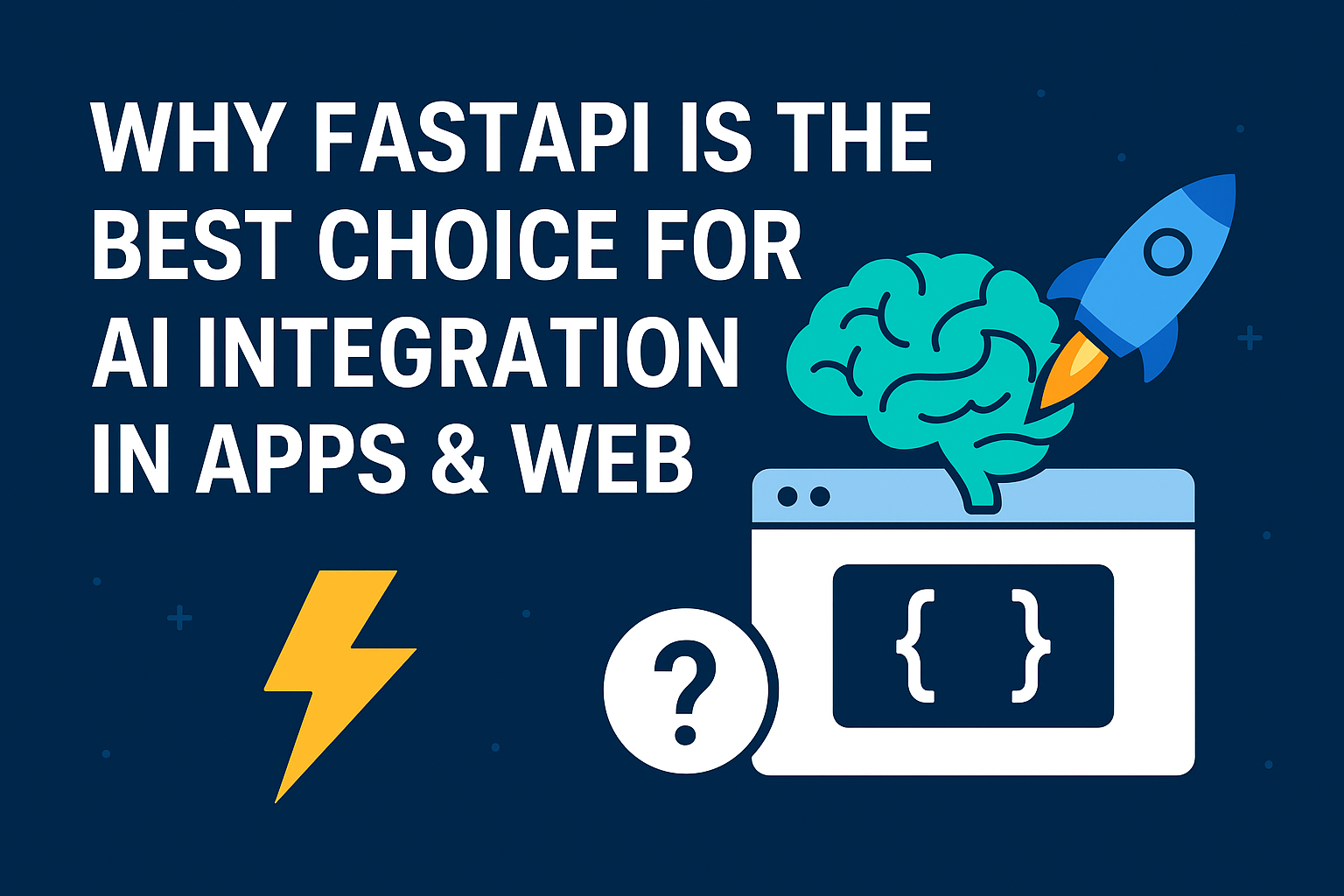
In the rapidly evolving world of app and web development, integrating artificial intelligence (AI) has become a game-changer. From chatbots to predictive analytics, AI powers smarter, user-centric experiences. But to deploy AI models effectively, you need a robust, scalable, and efficient backend. Enter FastAPI—a modern Python web framework that’s revolutionizing AI integration for apps and websites. In this blog, we explore why FastAPI stands out as the top choice for AI-driven projects, with tips to optimize your setup for performance and SEO. Let’s dive in! 🌟
FastAPI is a high-performance, asynchronous web framework for building APIs with Python. Built on Starlette and Pydantic, it combines speed, ease of use, and developer-friendly features. Its key strengths include:
Async support: Handles concurrent requests efficiently using Python’s asyncio.
Automatic documentation: Generates interactive API docs with Swagger UI.
Type safety: Leverages Pydantic for data validation and serialization.
High performance: Matches the speed of Node.js and Go, thanks to Starlette.
For AI integration, these features make FastAPI a powerhouse. Whether you’re deploying machine learning (ML) models, natural language processing (NLP) systems, or computer vision APIs, FastAPI delivers. Here’s why it’s better than alternatives like Flask or Django for AI-driven apps and web projects. 🚀
1. Blazing-Fast Performance ⚡
AI applications often involve heavy computations, such as processing large datasets or running real-time inference on ML models. FastAPI’s asynchronous capabilities allow it to handle thousands of concurrent requests with minimal latency. For example, when serving a TensorFlow or PyTorch model via an API, FastAPI’s async endpoints ensure quick responses, even under high traffic. This is critical for real-time AI apps like recommendation systems or chatbots. 🗣️
Compared to Flask (synchronous and slower for high concurrency) or Django (heavier and less optimized for async), FastAPI’s performance is closer to Node.js but with Python’s simplicity. This speed boosts user experience and improves SEO, as Google prioritizes fast-loading pages.
2. Seamless Model Deployment with Pydantic 📊
Deploying AI models requires robust data validation to ensure inputs and outputs are correct. FastAPI’s integration with Pydantic makes this effortless. Pydantic enforces type hints and validates JSON payloads, reducing errors when passing data to AI models. For instance, if your NLP model expects a specific input format, Pydantic ensures compliance before the request hits the model.
Here’s a sample FastAPI endpoint for an AI model:
from fastapi import FastAPI
from pydantic import BaseModel

app = FastAPI()

class TextInput(BaseModel):
    text: str

@app.post("/predict")
async def predict(input: TextInput):
    # Assume `model` is a preloaded AI model (e.g., Hugging Face transformer)
    prediction = model.predict(input.text)
    return {"prediction": prediction}
This code validates the input text field, ensuring it’s a string before processing. Pydantic’s type safety minimizes bugs, making FastAPI ideal for production-grade AI apps. ✅
Automatic API Documentation 📜
AI-driven apps often require collaboration between data scientists, backend developers, and frontend teams. FastAPI’s auto-generated Swagger UI and ReDoc documentation make it easy to share and test APIs. For example, a data scientist can deploy an ML model endpoint, and the frontend team can instantly explore it via Swagger UI. This reduces miscommunication and speeds up development. 🕒
The interactive docs also help when integrating APIs into mobile apps or websites, as developers can test endpoints directly. For SEO, well-documented APIs improve developer adoption, driving traffic to your app or site.
4. Scalability for AI Workloads 📈
AI applications often face unpredictable traffic spikes, especially for web-based tools like image recognition or real-time analytics. FastAPI’s async architecture scales effortlessly with tools like Uvicorn or Gunicorn. For heavy AI workloads, you can integrate FastAPI with:
Docker: Containerize your AI model and FastAPI app for easy deployment.
Kubernetes: Scale your API across clusters for high availability.
Celery: Offload time-intensive tasks (e.g., model training) to background workers.
This scalability ensures your AI app remains responsive, enhancing user satisfaction and SEO rankings (Google favors reliable, fast sites).
5. Easy Integration with AI Libraries 🤝
FastAPI plays nicely with popular AI/ML libraries like TensorFlow, PyTorch, Hugging Face, and scikit-learn. For example, you can load a pre-trained model and serve predictions via a FastAPI endpoint:
from fastapi import FastAPI
import torch

app = FastAPI()
model = torch.load("model.pth")  # Pre-trained PyTorch model

@app.get("/infer/{input_data}")
async def infer(input_data: float):
    prediction = model(torch.tensor([input_data])).item()
    return {"result": prediction}
This simplicity makes FastAPI ideal for rapid prototyping and production deployment of AI models. Plus, Python’s ecosystem ensures compatibility with cutting-edge AI tools. 🧑💻
6. SEO Benefits for Web Apps 🌐
For AI-powered web apps, SEO is critical to drive organic traffic. FastAPI supports SEO in several ways:
Fast APIs = Fast Pages: Quick API responses reduce page load times, a key Google ranking factor.
RESTful Design: Clean, structured APIs make it easier to integrate with frontend frameworks like React or Flutter, improving crawlability.
Structured Data: Add schema.org JSON-LD to your FastAPI responses to help search engines understand your content. For example:
@app.get("/schema")
async def get_schema():
    return {
        "@context": "https://schema.org",
        "@type": "WebApplication",
        "name": "AI-Powered App",
        "description": "A FastAPI-based app with AI integration."
    }
Static File Serving: Serve SEO-friendly static pages (e.g., landing pages) alongside your API using FastAPI’s StaticFiles.
By combining FastAPI’s speed with SEO best practices, your AI web app can rank higher on Google. 📊
Flask: Simple but synchronous, struggling with high-concurrency AI workloads. Lacks built-in async support and auto-docs.
Django: Great for traditional web apps but bloated for API-only AI projects. Slower than FastAPI for async tasks.
Node.js/Express: Fast but lacks Python’s rich AI ecosystem and type safety.
Go: High performance but less intuitive for AI model integration compared to Python.
FastAPI combines the best of both worlds: Python’s AI-friendly ecosystem and Node.js-like performance. 🎉
Use Async Endpoints: Leverage async def for non-blocking AI inference.
Containerize with Docker: Simplify deployment of AI models and FastAPI apps.
Monitor Performance: Use tools like Prometheus or New Relic to track API latency.
Secure Your APIs: Implement JWT or OAuth with FastAPI’s security module to protect AI endpoints.
Optimize for SEO: Ensure fast load times, clean URLs, and structured data for web apps.
FastAPI’s speed, scalability, and developer-friendly features make it the top choice for integrating AI into apps and web projects. Its async capabilities, Pydantic validation, and auto-generated docs streamline AI model deployment, while its performance boosts SEO for web apps. Whether you’re building a chatbot, recommendation engine, or image recognition tool, FastAPI delivers the flexibility and power you need. Start using FastAPI today to create AI-driven apps that perform flawlessly and rank high on Google! 🚀
Explore more at FastAPI’s official docs and share your AI projects with the community!
Your email address will not be published. Required fields are marked *